Sunday, August 20, 2006

The Long Tail

The Long Tail – Why the future of Business Is Selling Less of More by Chris Anderson.

I read Chris Anderson’s Wired column (that in many ways initiated the current discussion of The Long Tail) over Thanksgiving weekend 2004. I remember distinctly being at my uncle’s house in rural British Columbia sitting on an old couch in his eclectic second floor (see the photos- BTW I love this house, so much visual stimulation that it provides a great place for new ideas to flower)


and reading the article. At the time it seemed interesting but didn’t really hit home. I wasn’t quite able to see how this concept of the long tail applied to my life but I was intrigued. In retrospect, I realize that I was hanging out with a person (my uncle) that has lived most of his life pretty far out on the tail of traditional culture.

Again I've highlighted my comments in blue throughout the text below. The italics in the text are transcribed from the book. The bold is my editorial emphasis.

There are three primary concepts from this book that I wanted to mention. The first one has to do with time and the effect that our filters are having on the traditional time effect.


Page 142
“But there is another factor that influences popularity: age. Just as things of broad appeal tend to sell better than things of narrow appeal, new things tend to sell better than old things.”

“If you think about it, today’s hit is tomorrow’s niche. Almost all products, even hits, see their sales decay over time. Twister was the number two movie of 1996, but it’s DVD version is now outsold two-to-one on Amazon by a 2005 History Channel documentary on the French Revolution.

“Einstein described time as the fourth dimension of space; you can think of it equally as the fourth dimension of the Long Tail. Both hits and niches see their sales slow over time; hits may start higher, but they all end up down the Tail eventually. The research to quantify this conclusion is continuing, but conceptually the picture looks like the graph on the next page [see image titled "Time tails"].

“What’s particularly interesting about time and the Long Tail is that Google appears to be changing the rules of the game. For online media, like media anywhere, there is a tyranny of the new. Yesterday’s news is fish wrap, and once content falls off the front page of a Web site, its popularity plummets. But as sites find more and more of their traffic coming from Google, they’re seeing this rule break.

“Google is not quite time-agnostic, but it does measure relevance mostly in terms of incoming links, not newness. So when you search for a term, you’re more likely to get the best page than the newest one. And because older pages have more time to attract incoming links, they sometimes have an advantage over the newer ones. The result is that the usual decay of popularity for blog posts and online news pages is now much more gradual than it was thanks to the amount of traffic that comes via search. Google is in a sense serving as a time machine, and we’re just now being able to measure the effect that has on publishing, advertising, and attention.”

I think the impact filters such as Google are having in regard to finding things that are “older” and therefore in the tail is incredible. Anderson provides several other examples of media that was overlooked when it was produced that resurfaced later due to the technologies available in the filters. He begins chapter 1 with the story of Touching the Void and how this story resurfaced years after it was first written thanks to Amazon’s “people who bought also bought…” feature.

The second idea I wanted to mention has to do with microculultures. Thanks to the filter technologies we are finally able to indulge many of our long tail preferences and interests. I think this is great but it can sure make it difficult to talk to my neighbors. We just don’t share the same reference points the way we used to.


Page 182
"I decided to test other cultural touchstones to see if they were as widely held as I had thought. I started by running a few other clichés from my little online world past real-world friends: “All Your Base Are Belong To Us”; “More Cowbell!” “I for one welcome our new [fill in the blank] overlords,” and so on. Turns out that these snippets of culture that I thought were ubiquitous are actually pretty obscure, even in my own office. When I took an informal poll at a public relations conference at which I was speaking, I found that only about 10 percent of the audience had heard of any of them – and for each phrase it was a different 10 percent.

"What does this show? It shows that my tribe is not always your tribe, even if we work together, play together, and otherwise live in the same world. Same bed, different dreams.

"The same Long Tail forces and technologies that are leading to an explosion of variety and abundant choice in the content we consume are also tending to lead us into tribal eddies. When mass culture breaks apart, it doesn’t re-form into a different mass. Instead, it turns into millions of microcultures, which coexist and interact in a baffling array of ways.

"As a result, we cannot treat culture not a one big blanket, but as the superposition of many interwoven threads, each of which is individually addressable and connects different groups of people simultaneously.

In short, we’re seeing a shift from mass culture to massively parallel culture. Whether we thing "of it this way or not, each of us belongs to many different tribes simultaneously, often overlapping (geek culture and LEGO), often not (tennis and punk-funk). We share some interests with our colleagues and some with our families, but not all of our interests. Increasingly, we have other people to share them with, people we have never met or even think of as individuals (e.g., blog authors or playlist creators).

"Virginia Postrel observed that the variety boom is nothing more than a reflection of the diversity inherent in any population distribution:
  1. Every aspect of human identity, from size, shape, and color to sexual proclivities and intellectual gifts, comes in a wide range. Most of us cluster somewhere in the middle of most statistical distributions. But there are lots of bell curves, and pretty much everyone is on a tail of t least one of them. We may collect strange memorabilia or read esoteric books, hold unusual religious beliefs or wear odd-sized shoes, suffer rare diseases or enjoy obscure movies.
"This has always been true, but it’s only now something we can act on. The resulting rise of niche culture will reshape the social landscape. People are re-forming into thousands of cultural tribes of interest, connected less by geographic proximity and workplace chatter than by shared interests. In other words, we’re leaving the water-cooler era, when most of us listened, watched, and read from the same, relatively small pool of mostly hit content. And we’re entering the microculture era, when we’re all into different things."

I think we’re just at the beginning of discovering how this trend is going to impact our communities. Part of the reason I write this blog is to give other people a window into the microcultures that I’m spending my time in.

The third idea I wanted to touch on has to do with “who is in control of all of this”. The following passage discusses this in the world of newspapers and bloggers but I think that this passage could easily apply to music, film/video and other types of content just as easily.


Page 188
"In Letters to a Young Contrarian, Christopher Hitchens writes that he wakes up every morning and checks his vital signs by grapping the front page of the New York Times: “’All the News That’s Fit to Print,’ it says. It’s been saying that for decades, day in and day out. I imagine that most readers of the canonical sheet have long ceased to notice the bannered and flaunted symbol of its mental furniture. I myself check every day to make sure that it still irritates me. If I can still exclaim, under my breath, why do they insult me and what do they take me for and what the hell is it supposed to mean unless it’s an obviously complacent and conceited and censorious as it seems to be, then at least I know that I still have a pulse.”

"As Jerry Sienfeld quips, “It’s amazing that the amount of news that happens in the world every day always just exactly fits the newspaper.”

"The reality, slogan aside, is that the New York Times now competes not only with other New York City newspapers and newspapers elsewhere, but also with the collective wisdom and information of everyone online. Authority is in the eye of the beholder; it is not innate to the institution itself. It is a credit to the Times journalists and editors that they do so well, continuing to break news and set the agenda, despite this. But news and information is clearly no longer the exclusive domain of professionals.

"With an estimated 15 million bloggers out there, the odds that a few will have something important and insightful to say are good and getting better. And as our filters improve, the odds that we’ll see them are getting better, too. From a mainstream media perspective, this is simply more competition, whatever the source. And some audiences will prefer it. Like it or not, fragmentation is inevitable."

Now that I think about this a bit more I realize that I’ve been using bloggers as a tool to point me to specific media items. I often like the filters that bloggers provide better than skimming the list of headlines on a newspaper home page.

Saturday, August 19, 2006

The Tipping Point

Over the last couple of years I’ve been part of a number of different conversations about both The Tipping Point and Blink, both by Malcolm Gladwell. Up to this point I haven’t read either one but feel like I have based on all of these conversations. I decided it was time to sit down and flip through them to see what else I’ve been missing. Here are a few thoughts about The Tipping Point.

In general I was a bit disappointed in the book. Maybe there’s been too much discussion of the book over the last couple of years and it was bound to fall short of my expectations. I was expecting more academic rigor rather that his colloquial approach of presenting a concept and the selecting stories that support the concept. Seemed to be a bit sloppy to me. However, that doesn’t mean the ideas aren’t powerful, I would just like to see more research on the specific assertions that Gladwell makes.

Page 259 The last paragraph of the whole book
“But if there is difficulty and volatility in the world of the Tipping Point, there is a large measure of hopefulness as well. Merely by manipulating the size of a group, we can dramatically improve its receptivity to new ideas. By tinkering with the presentation of information, we can significantly improve its stickiness. Simply by finding and reaching those few special people who hold so much social power, we can shape the course of social epidemics. In the end, Tipping points are a reaffirmation of the potential for change and the power if intelligent action. Look at the world around you. It may seem like an immovable, implacable place. It is not. With the slightest push – in just the right place – it can be tipped.”

I think that this paragraph summarizes the entire book quite well. The key is to remember that small things can make a big difference. The art and magic of creating Tipping Points is not easy to learn. I sure don’t feel like I would know where to begin based on the examples he provided. I have some sense for what he is talking about and may be able to recognize a Tipping Point in the rearveiw mirror, but making it happen is either an art I don’t understand or a formula that he decided not to share with the rest of us. I suspect it’s the former.

Wednesday, August 16, 2006

Cradle to Cradle – Remaking the Way We make Things

I've had a copy of Cradle to Cradle – Remaking the Way We make Things
By William McDonough and Michael Braungart
sitting on my bookshelf for about a year. I started reading it last winter but didn't finish. I was looking forward to having a chance to dig back in and have recently done so.

I'm starting into this theme of writing up little book reports and this post will be the second entry in that pattern. Once again I'm going to have to quote pretty big chunks of the text in order to capture the ideas I'm interested in. If you find any of this fascinating I would suggest taking the time to read the whole book as I'm just skimming the surface of a couple of ideas.

I've highlighted my comments in blue throughout the text below. The italics in the text are transcribed from the book. The bold is my editorial emphasis.


There are a couple of ideas that I picked up on in this book. The first one is the difference between eco-efficiency (loosely defined as optimizing our current systems to pollute less, produce less waste and burn more fuel) and eco-effectiveness (loosely defined as designing systems up front to be healthful for profits, the environment and the people involved) and the implications that each approach has for our societies.

Page 66
Environmental destruction is a complex system in its own right - widespread, with deeper causes that are difficult to see and understand. Like our ancestors, we may react automatically, with terror and guilt, and we may look for ways to purge ourselves - which the “eco-efficiency” movement provides in abundance, with its exhortations to consume and produce less by minimizing, avoiding, reducing and sacrificing. Humans are condemned as the one species on the planet guilty of burdening it beyond what it can withstand; as such, we must shrink our presence, our systems, our activities, and even our populations so as to become almost invisible. (Those who believe population is the root of our ills think people should mostly stop having children.) The goal is zero: zero waste, zero emissions, zero “ecological footprint.”

As long as human beings are regarded as “bad,” zero is a good goal. But to be less bad is to accept things are they are, to believe that poorly designed, dishonorable, destructive systems are the best humans can do. This is the ultimate failure of the “be less bad” approach: a failure of the imagination. From our perspective, this is a depressing vision of our species’ role in the world.

What about an entirely different model? What would it mean to be 100 percent good?

These two simple questions may be the most powerful idea in this whole book and I believe are worth looking into more deeply. Reframing our industrial and social systems to be 100 percent good for people, the planet and our economy is a wild idea that taps into deep energy. Continuing...

Page 90
Is our goal to starve ourselves? To deprive ourselves of our own culture, our own industries, our own presence on the planet, to aim for zero? How inspiring a goal is that? Wouldn’t it be wonderful if, rather than bemoaning human industry, we had reason to champion it? If environmentalists as well as automobile makers could applaud every time someone exchanged an old car for a new one, because new cars purified the air and produced drinking water? If new buildings imitated trees, providing shade, songbird habitat, food, energy, and clean water? If each new addition to a human community deepened ecological and cultural as well as economic wealth? If modern societies were perceived as increasing assets and delights on a very large scale, instead of bringing the planet to the brink of disaster?

We would like to suggest a new design assignment. Instead of fine-tuning the existing destructive framework, why don’t people and industries set out to create the following:
  • Buildings that, like trees, produce more energy than they consume and purify their own waste water
  • Factories that produce effluents that are drinking water
  • Products that, when their useful life is over, do not become useless waste but can be tossed onto the ground to decompose and become food for plants and animals and nutrients for soil; or, alternately, that can return to industrial cycles to supply high quality raw materials for new products
  • Billions, even trillions, of dollars’ worth of materials accrued for human and natural purposes each year
  • Transportation that improves the quality of life while delivering goods and services
  • A world of abundance, not one of limits, pollution and waste.

And the second main theme has to do with how we can change our approach to design with the idea of eco-effectiveness squarely in the center of the process.

Page 103
The overarching design framework we exist within has two essential elements: mass (the Earth) and energy (the sun). Nothing goes in or out of the planetary system except for heat and the occasional meteorite. Otherwise, for our practical purposes, the system is closed, and its basic elements are valuable and finite. What ever is naturally here is all we have. Whatever humans make des not go “away.”

If our systems contaminate Earth’s biological mass and continue to throw away technical materials (such as metals) or render them useless, we will indeed live in a world of limits, where production and consumption are restrained, and the Earth will literally become a grave.

If humans are truly going to prosper, we will have to learn to imitate nature’s highly effective cradle-to-cradle system of nutrient flow and metabolism, in which the very concept of waste does not exist. To eliminate the concept of waste means to design things - products, packaging, and systems-from the very beginning on the understanding that waste does not exist. It means that the valuable nutrients contained in the materials shape and determine the design: form follows evolution, not just function. We think this is a more robust prospect than the current way of making things.

As we indicated, there are two discrete metabolisms on the planet. The first is the biological metabolism, or the biosphere - the cycles of nature. The second is the technical metabolism, of the technosphere - the cycles of industry, including the harvesting of technical materials from natural places. With the right design, all of the products and materials manufactured by industry will safely feed these two metabolisms, providing nourishment for something new.

Products can be composed either of materials that biodegrade and become food for biological cycles, or of technical materials that stay in closed –loop technical cycles, in which they continually circulate as valuable nutrients for industry. In order for these two metabolisms to remain healthy, valuable and successful, great care must be taken to avoid contaminating one with the other. Things that go into the organic metabolism must not contain mutagens, carcinogens, persistent toxins, or other substances that accumulate in natural systems to damaging effect. (Some materials that would damage the biological metabolism, however, could be safely handled by the technical metabolism.) By the same token, biological nutrients are not designed to be fed into the technical metabolism, where they would not only be lost to the biosphere but would weaken the quality of technical materials or make their retrieval and reuse more complicated.

Page 131
In the long run, connecting to natural energy flows is a matter of reestablishing our fundamental connection to the source of all good growth on the planet: the sun, that tremendous nuclear power plant 93 million miles away (exactly where we want it). Even at such distances, the sun’s heat can be devastating, and it commands a healthy respect for the delicate orchestration of circumstances that makes natural energy flows possible. Humans thrive on the earth under such intense emanations of heat and light only because billions of years of evolutionary processes have created the atmosphere and surface that support our existence - the soil, plant life, and cloud cover that cool the planet down and distribute water around it, keeping the atmosphere within a temperate range that we can live in. So reestablishing our connection to the sun by definition includes maintaining interdependence with all the other ecological circumstances that make natural energy flows possible in the first place.

The third major theme has to do with how our concepts of how things should work can be taken to extremes to the point of not functioning.

Page 147
A Diversity of “Isms”

Ultimately, it is the agenda with which we approach the making of things that must be truly diverse. To concentrate on any single criterion creates instability in the larger context, and represents what we call an “ism,” an extreme position disconnected from the overall structure. And we know from human history the havoc an ism can create-think of the consequences of fascism, racism, sexism, Nazism, or terrorism.

Consider two manifestos that have shaped industrial systems: Adam Smith’s Inquiry into the Nature and Causes of the Wealth of Nations (1776), and The Communist Manifesto by Karl Marx and Friedrich Engels (1848). In the first manifesto - written when England was still trying to monopolize her colonies and published the same year as the Declaration of Independence - Smith discounts empire and argues for the value of free trade. He links a country’s wealth and productivity with general improvement, claiming that “every man working for his own selfish interest will be led by an invisible hand to promote the public good.” Smith was a man whose beliefs and work centered on moral as well as economic forces. Thus, the invisible hand he imagined would regulate commercial standards and ward of injustice would have been working in a market full of “moral” people making individual choices - an ideal of the eighteenth century, not necessarily a reality of the twenty-first.

Unfair distribution of wealth and worker exploitation inspired Marx and Engels to write The Communist Manifesto, in which they sounded an alarm for the need to address human rights and share economic wealth. “Masses of laborers, crowded into the factory, are organized like soldiers…they are daily and hourly enslaved by the machine, by the foreman, and, above all, by the individual bourgeois manufacturer himself.” While capitalism had often ignored the interest of the worker in pursuit of its economic goals, socialism, when singly-mindedly pursued as an ism, also failed. If nothing belongs to anyone but the state, the individual can be diminished by the system. This happened in the former USSR, where government denied fundamental human rights such as freedom of speech. The environment also suffered: scientists have deemed 16 percent of the former Soviet state unsafe to inhabit, due to industrial pollution and contamination so sever it has been termed “ecocide.”

In the United States, England and other countries, capitalism flourished, in some places informed by an interest in social welfare combined with economic growth (for example, with Henry Ford’s recognition that “cars cannot buy cars”) and regulated to reduce pollution. But environmental problems grew. In 1962 Rachel Carson’s Silent Spring promoted a new agenda – ecologism - that steadily gained adherents. Since then, in response to growing environmental concerns, individuals, communities, government agencies, and environmental groups have offered various strategies for protecting nature, conserving resources, and cleaning up pollution.

All three of these manifestos were inspired by a genuine desire to improve the human condition, and all three had their triumphs as well as their perceived failures. But taken to extremes - reduced to isms - the stances they inspired can neglect factors crucial to long-term success, such as social fairness, the diversity of human culture, and the health of the environment. Carson sent an important warning to the world, but even ecological concern, stretched to an ism, can neglect social, cultural and economic concerns to the detriment of the whole system.

“How can you work with them?” we are often asked, regarding our willingness to work with every sector of the economy, including big corporations. To which we sometimes reply, “how can you not work with them?” (We think of Emerson visiting Thoreau when he was jailed for not paying his taxes - part of his civil disobedience. “What are you doing in there?” Emerson is said to have asked, prompting Thoreau’s famous retort: “What are you doing out there?”

Our questioners often believe that the interests of commerce and the environment are inherently in conflict, and that environmentalists who work with big business have sold out. And businesspeople have their own biases about environmentalists and social activists, whom they often see as extremists promoting ugly, troublesome, low-tech, and impossibly expensive designs and policies. The conventional wisdom seems to be that you sit on one side of the fence or the other.

Some philosophies marry two of the ostensibly competing sectors, propounding the notion of a “social market economy,” or “business for social responsibility,” or “natural capitalism” - capitalism that takes into account the values of natural systems and resources, an idea famously associated with Herman Daly. Clearly these dyads can have a broadening effect. But too often they represent uneasy alliances, not true unions of purpose. Eco-effectiveness sees commerce as the engine of change, and honors its need to function quickly and productively. But it also recognizes that if commerce shuns environmental social, and cultural concerns, it will produce a large-scale tragedy of the commons, destroying valuable natural and human resources for generation to come. Eco-effectiveness celebrates commerce and the commonwealth in which it is rooted.

When people hear about the work that I want to do in renewable energy they often seem to assume that I will be working for a non-profit. This assumption seems to reflect the sentiment expressed above by the questioners that ask "how can you work with them". I believe that for "alternative energy" to be able to drop the alternative label these energy sources will have to be developed in a way that allows prices to be competitive with or better than fossil fuel sources for both the consumer and producer, therefore making them very lucrative. This pretty much means that I'm going to be working with or for "them" and I'm looking forward to it.

And the fourth theme has to do with turning the Triple Bottom Line into the Triple Top Line. Again a much more positive way of shaping things that seems to provide for much more interesting outcomes.

Page 153
“The Triple Top Line”

The conventional design criteria are a tripod: cost, aesthetics, and performance. Can we profit from it? The company asks. Will the customer find it attractive? And will it work? Champions of “sustainable development” like to use a “triple bottom line” approach based on the tripod of Ecology, Equity and Economy. This approach has had a major positive effect on efforts to incorporate sustainability concerns into corporate accountability. But in practice we find that it often appears to center only on economic considerations, with social or ecological benefits considered as an afterthought rather than given equal weight at the outset. Businesses calculate their conventional economic profitability and add to that what they perceive to be the social benefits, with, perhaps, some reduction in environmental damage - lower emissions, fewer materials sent to a landfill, reduced materials in the product itself. In other words, they assess their health as they always have – economically - and then tack on bonus points for eco-efficiency, reduced accidents or product liabilities, jobs created, and philanthropy.

If businesses are not using triple bottom line analysis as a strategic design tool, they are missing a rich opportunity. The real magic results when industry begins with all these questions, addressing them up front as “triple top line” questions rather than turning to them after the fact. Used as a design tool, the fractal allows the designer to create value in all three sectors. In fact, often a project that begins with pronounced concerns of Ecology or Equity (how do I create habitat? How can I create jobs?) can turn out to be tremendously productive financially in ways that would never have been imagined if you’d started from a purely economic perspective.

In the book William and Michael provide numerous examples of their ideas in action. I won't even begin to try to summarize those examples. These ideas I've sketched out here are going to tumble around in my head for a while and I hope to write about them again in the future.

Sunday, August 13, 2006

First Day of the Program at Unistar

Camp Unistar August 12-19
Harry Potter and Philosophy

Sunday Day One: The Sorting: Introduction, what is character?

Started off with a reading from one of the books regarding an interaction between HP and Dumbledore about the Mirror of Arasid, which shows you your greatest wish, “The happiest man on earth would be able to look into the mirror and see his reflection”.

Other introductory info provided about how the week will go.

Provided hand out titled “Is Ambition a Virtue? Why Slytherin Belongs at Hogwarts” from the book Harry Potter and Philosophy. http://search.barnesandnoble.com/booksearch/isbninquiry.asp?z=y&ean=9780812694550&displayonly=TOC

What is your favorite thing about the books, favorite book, etc? For me it is the relationship between Voldomort/Death Eaters and Harry, Dumbledore and the Order of the Phoneix. They both need each other to define themselves. I think this translates to the world we live in.

The questions of
“What is evil?”

“How do people define evil for themselves?”

“Why is there apparent universal agreement that Voldomort and the Death Eaters are evil?”

The last 150 pages of book 6 were my favorite part. I’m not sure why yet but will re-read this week to see what jumps out. I think it has to do with the role of Snape and trying to figure out which side he is on. Is he really still loyal to Voldomort or is he a double agent and Dumbledore and Snape conspired to provide Dumbledore a way to go underground?

Everyone in the group shared their own answer to this question and the answers were a unique as the people in the group. Not one response was the same as the others. These introductions were a great way to build a group dynamic and set the tone for the discussion.

Three Harry Potter trivia questions:
What is quidditch? A game that the magical world plays played on brooms and a Snitch?
What are the names of the three balls? Quaffle, Snitch and Bluddger?

The name of the captain of the Holy Head Harpies? Gwenog Jones

What does the word Philosophy mena? Love of knowledge or wisdom.

Name a philosopher from one of these periods? Ancitnet, Midevil, Modern, 20th Century.

What does Epistemology mean? http://en.wikipedia.org/wiki/Epistemology

Craig Provided a brief description of western philosophy. I missed most of this but here is a link to wikipedia about this topic that provides a lot of the same content. http://en.wikipedia.org/wiki/History_of_Philosophy

Someone asked what deconstructionist means. Here is wikipedia’s definition: http://en.wikipedia.org/wiki/Deconstruction

Metaphysics: http://en.wikipedia.org/wiki/Metaphysics

Ontology: http://en.wikipedia.org/wiki/Ontology

Next we performed our sorting. based on a series of questions on the back of one of the hand outs. Here were my answers highlighted in yellow:

1. I prefer making decisions: A after finding out what others think B without consulting others.
2. I prefer being called A Imaginative or intuitive B factual and accurate.
3. I prefer making decisions A about people based on facts and data B about people based on empathy and feelings
4. I prefer commitments A to occur if others want to make them B to be definite and to ensure they are made
5. I prefer A quiet, thoughtful time alone B Active, energetic time with people.
6. I prefer to A Use methods I know well to get the job done B think of new methods fordoing tasks.
7. I prefer drawing conclusions A based on logic and step by step analysis B based on what I feel from past experiences
8. I prefer A avoiding making deadlines B setting a schedule and sticking to it
9. I prefer talking A a while then thinking to myself B freely for an extended period, thinking later
10. I prefer A thinking about possibilities B dealing with actualities
11. I prefer being thought of A as a thinking person B as a feeling person
12. I prefer A considering all possibilities before making a decision B making quick decisions abased on the info at hand
13. I prefer A inner thoughts and feelings others cannot see B activities involving others
14. I prefer A the abstract or theoretical B the concrete or real
15. I prefer helping others A explore their feelings B make logical decisions
16. I prefer A change and keeping options open B predictability and knowing in advance
17. I prefer communicating A little of my inner thinking and feelings B freely my inner thinking and feelings
18. I prefer A possible views of the whole B the factual details available
19. I prefer using A common sense to make decisions B dada, analysis and reason to make decisions
20. I prefer planning A ahead based on projections B as necessities arise
21. I prefer A meeting new people B being alone, or with one person I know well
22. I prefer A ideas B facts
23. I prefer A convictions B verifiable conclusions
24. I prefer A using appointment books as much as possible B using appointment books as little as possible
25. I prefer A discussing new issues at length in a group B puzzling out ideas in my mind, and then sharing
26. I prefer A carrying out plans with precision B designing plans, not necessarily carrying them out
27. I prefer A logical people B feeling people
28. I prefer A being free to do things spur of the moment B knowing in advance what I’m expected to do
29. I prefer being A the center of attention B in the background
30. I prefer A imagining the nonexistent B examining details of the actual
31. I prefer A experiencing emotional situations B using my ability to analyze situations
32. I prefer starting meetings A at a prearranged time B when all are comfortable or ready

The results of this gives us a Myers Briggs types that can be mapped to houses

(Here is an example of one of the quizes online - http://quizilla.com/users/ReaderRavenclaw/quizzes/Hogwarts%20Sorting%20Hat%3A%20Based%20on%20Myers-Briggs%20Personality%20Typing)

I’m an INTJ

Last three letters of type
STJ = Hufflepuff
SFJ = Hufflepuff
NTP = Ravenclaw
NFP = Ravenclaw
NTJ = Ravenclaw
STP = Girffendore
SFP = Griffendore
NFP = Griffendore
NTP = Slytherin
NTJ = Slytherin

Here is more info about Myers Briggs: http://en.wikipedia.org/wiki/Myers_Briggs

Friday, August 11, 2006

Management Styles and the Impact on Motivation

After re-reading this post I decided that the message I was trying to express got lost somewhere along the way. The core insight that Joel's posts provided for me was realizing how important intrinsic motivation is for me to be able to sustain my enthusiasm for a job, a hobby or anything else that I put my time and energy into. The post seemed to drift much more toward my feelings about the other management styles and that isn't where I wanted to go.

I'm going to try to rework this post and re-publish in the next couple of days. At times it can be helpful for me to see my own writing to realize that I didn't quite express myself the way I was intending. Sorry for going off track a bit.

Wednesday, August 09, 2006

Al Gore - "What you can do"

This video of Al Gore is from TED 2006 and was a special request by the organizers as a follow up to his regular slide show. In this one he talks more about the things we can do about climate change. In his regular slide show he is focused more on "what is happening" and "why you should care". I think you'll find it interesting.

http://tedblog.typepad.com/tedblog/2006/06/al_gore_on_tedt.html

Saturday, August 05, 2006

Salsa Performance This Friday

The Salsa Performance Team (we still need to come up with a name) that I've been practicing with for the last month has our first performance this coming Friday (8/4/06). It will be during Club Salsero at Cinema Ballroom in St Paul. Our performance will be sometime between 10 and 11 PM. We're also planning to perform around 10 or 10:15 next Tuesday (8/8/06) at Trocaderos Night Club in Minneapolis.

I'll try to post a link to the YouTube video sometime next week.

Should be fun! Feel free to come by to see for yourself.

Here is the "So You Think You Can Dance" video on YouTube
http://youtube.com/watch?v=JO5eGcZOSOU

Also, it looks like Trocaderos is no longer having Tuesday night salsa so our performance there has been cancelled.

Wednesday, August 02, 2006

Twins Territory

I went to the Twins game that started at 12:15 PM. I met a couple friends there and happened to have my laptop with me. The Twins were loosing bigtime and it was getting a little boring so I decided to see if there was a wireless network in the stadium. Turns out there is! It's called "Twins Territory" and appears to be an open high speed network. Very Cool!

I can imagine going to other games as a place to work. You can get a Cheap Seats (outfield upper deck GA) ticket for $6 and it's a pretty nice atmosphere. Certianly different than sitting at the desk.

If you're interested in joining me for a game let me know!

Tuesday, August 01, 2006

Two Questions and One Long Answer

I recently received an email that included the following two questions.

“What are your thoughts on how your IT skills might be transferred to the renewable energy field?”

“Are you thinking of the business side or the non-profit side more?”

My response to these questions surprised me a little bit and helped me to frame what I’m doing. I wanted to post this response in this forum as well and see if anyone has any comments.

Good questions. My response has gotten a little long but both of your questions open up a lot of territory!

I’m open to working in a for-profit, non-profit, governmental or academic organization. I believe that it will be possible for me to utilize my skills, experience and enthusiasm to work on renewable energy from any of these perspectives. However, I do believe that it’s critical that renewable energy continue to develop in such a way that it is financially competitive (if not superior) to fossil fuel energy for both the producer and consumer. As long as people have to pay a premium renewables will remain alternative rather than go mainstream. I believe that all four types of organizations have a key role to play in creating a sustainable energy future. That said, my experience in IT has all been in for-profit companies and I’m quite happy working in that environment.

I believe that technology provides tools for people to solve problems and maximize the potential presented by opportunities. This is the spirit that I bring to my exploration of how I can use my background in the renewable energy field. I’m primarily interested in understanding the challenges the renewable energy industry is facing and then look for ways that I can apply my skill set to make a difference.

The digital world we live in requires software and IT systems in an amazingly diverse number of areas. The possibilities I see for how I can apply my IT/software background is equally diverse. Here are some of the ideas that have surfaced during my investigation:

• Consumer Education

o Carbon and other types of calculators (for example http://www.climatecrisis.net/takeaction/carboncalculator/). What is the next generation of calculator going to look like? How will efficiency opportunities be incorporated in the calculators?

o Web based marketing and education campaigns. Eyeballs are looking at the web around the world making this is a fantastic medium. One of my client groups at Target was On-line Marketing and I can see how a number of the things that Target did to build brand could be applied to renewable energy education and enrollment such as games, contests, and user submitted content (movies, stories, songs, art work, etc).

• Community Organizing

o Creating web based applications that allow neighbors to work together to change the energy choices in their community. Community owned solar or wind project. “Ask your neighbor” discussion forums. Offering ways for people to express their desire for sustainable energy options.

o Credit trading systems such as the Chicago Climate Exchange (http://www.chicagoclimatex.com/)

• Distributed Generation Management

o Creating/enhancing software to monitor distributed power generation and maximizes the financial reward (use immediately, store for the future or sell back to grid).

• Centralized Generation

o What systems are used to monitor and control turbines in wind farms?

o New approaches to solar (http://www.stirlingenergy.com/) may require specialized software and systems.

• Modeling – applies to both Distributed and Centralized Generation

o Refining models of wind speed and available energy

o Consumer Information about Solar – see http://www.technologyreview.com/read_article.aspx?id=17129&ch=biztech for bit about plan to create a web application that will provide consumers and builders information about wattage they can expect from integrated solar systems.

o Ocean wave and tidal energy.

• Marketing of renewable energy solutions

o Renewable energy carbon offset purchasing

o Providing online tools for people to see the financial and aesthetic impact of different energy system options.

• Holistic solution design

o Provide tools (wikis, discussion forums, VOIP conferences) for interdisciplinary and geographically disparate teams to work together on projects. Projects often require significant involvement from business, design and technical experts to be successful.

• Appliance manufacturing (i.e. solar photovoltaic panels and membranes, wind turbines, geothermal systems) companies have information management challenges. I could work directly for one of these organizations. For Example SunPower, SunTech or Evergreen Solar.

• Building construction and renovation

o Streamline the LEED certification and application process through on-line tools. I understand that USGBC has been working with Adobe to do this.

• Demand management

o Smart appliances that can monitor grid demand and operate a lowest cost or most efficient times.

o Feedback systems to allow people to see the complete cost of their energy consumption patterns. The interfaces for these systems could be built into cell phones, PDAs and other items that we keep close to us on regular basis. You could hit a button on your phone to see your carbon footprint for the day with a couple of simple suggestions for what you could do to change the pattern. Data could come from things as diverse as your car, your electric utility, your refrigerator, and your computer.

• Financial Modeling. Are there customized solutions needed to support the financial models used to argue for public policy, corporate policy and personal choices?

• Bio Fuels.

o Manufacturing facility monitoring and control. Are there any special needs of the bio fuel industry that are not currently being addressed?

o Research into cellulosic ethanol technology. My undergrad degree is in biochemistry. I imagine that these companies create mountains of data that has to be managed and presented in such a way as to be usable.

• Distribution and Grid management.

o Transmission capacity. Provide tools for a consumer/developer to be able to negotiate with the utility?

o Location, Location, Location. How do we get power produced in one location to a consumer in a different location? Are there “better” ways to manage this that require software to make real-time decisions and provide feedback?


As I mentioned in my initial email, I’m most interested in distributed generation. There are two reasons for this. First, I’m a strong believer in enabling people to participate. Distributed generation allows many more people to be contributors and consumers rather than just consumers. Second, more diversity in a system makes it more stable, flexible, reliable and secure. In IT this is called avoiding single points of failure. In natural ecosystems we call this biodiversity.

Saturday, July 29, 2006

Stumbling on Happiness

I recently picked up a copy of "Stumbling on Happiness" by Daniel Gilbert. Great book! Fantastic information presented in an accessible and humorous way. This one is a gem.

I wanted to write a couple of notes about this book. As I started into this exercise I realized that I was actually going to have to quote pretty big chunks of the text in order to capture the ideas I'm interested in. If you find any of this fascinating I would suggest taking the time to read the whole book as I'm just skimming the surface of a couple of ideas.

I've highlighted my comments in blue throughout the text below. The italics in the text are transcribed from the book. The bold is my editorial emphasis.


Page 125
“I’ve been waiting a long, long time to show someone this cartoon (figure 12), which I clipped from a newspaper in 1983 and have kept tacked to one bulletin board or another ever since. It never fails to delight me. The sponge is being asked to imagine without limits-to envision what it might like to be if the entire universe of possibilities were open to it-and the most exotic thing it can imagine becoming is an arthropod. The cartoonist isn’t making fun of sponges, of course; he’s making fun of us. Each of us is trapped in a place, a time, and a circumstance, and our attempts to use our minds to transcend those boundaries are, more often than not, ineffective. Like the sponge, we think we are thinking outside the box only because we can’t see how big the box really is. Imagination cannot easily transcend the boundaries of the present, and one reason for this is that it must borrow machinery that is owned by perception. The fact that these two processes must run on the same platform means that we are sometimes confused about which one is running. We assume that what we feel as we imagine the future is what we’ll feel when we get there, but in fact, what we feel as we imagine the future is often a response to what’s happening in the present. The time-share arrangement between perception and imagination is one of the causes of presentism, but it is not the only one.”
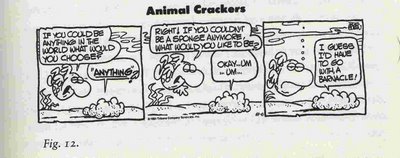
This idea is the reason that I decided that it was not only a good idea but also necessary for me to leave my last job prior to accepting my next position - or even really exploring the possibilities to any great depth. While working in my previous position I couldn't see "how big the box really is" and I knew that. I didn't always have the words available to me to explain this concept.

Page 109
“Presentism defined: The tendency for current experience to influence one’s views of the past and the future.”

I wanted to include this definition because I believe this is an incredibly useful word and I couldn't seem to remember what it meant. Wirting it down helps!

Page 161
“The research I’ve described so far seems to suggest that human beings are hopelessly Panglossian; there are more ways to think about experience than there are experiences to think about, and human beings are unusually inventive when it comes to finding the best of all possible ways. And yet, if this is true, then why aren’t we all walking around with wide eyes and loopy grins, thanking God for the wonder of hemorrhoids and the miracle of in-laws? Because the mind may be gullible, but it ain’t no patsy. The world is this way, we wish the world were that way, and our experience of the world-how we see it, remember it, and imagine it-is a mixture of stark reality and comforting illusion. We can’t spare either. If we were to experience the world exactly as it is, we’d be too depressed to get out of bed in the morning, but if we were to experience the world exactly as we want it to be, we’d be too deluded to find our slippers. We may see the world through rose-colored glasses, but roes-colored glasses are neither opaque nor clear. They can’t be opaque because we need to see the world clearly enough to participate in it-to pilot helicopters, harvest corn, diaper babies, and all the other stuff that smart mammals need to do in order to survive and thrive. But they can’t be clear because we need their rosy tint to motivate us to design the helicopters (“I’m sure this thing will fly”), plant the corn (“This year will be a banner crop”), and tolerate the babies (“What a bundle of joy!”). We cannot do without reality and we cannot do without illusion. Each serves a purpose, each imposes a limit on the influence of the other, and our experience of the world is the artful compromise that these tough competitors negotiate.”

I love this concept that we have to live in a mix of illusion and reality. We each find out own place within this balance and it helps me to see how different people can have such different impressions of the same thing.

Page 163
“Most of us pot a lot of stock in what scientists tell us because we know that scientists reach their conclusions by gather and analyzing facts…Scientists are credible because they draw conclusions from observations, and ever since the empiricists trumped the dogmatists and because the kings of ancient Greek medicine, westerners have had a special reverence for conclusions that are based on things they can see. It isn’t surprising, then, that we consider our own views credible when they are based on observable facts but not when they are based on wishes, wants and fancies. We might like to believe that everyone loves us, that we will live forever, and that high-tech stocks are preparing to make a major comeback, and it would be awfully convenient if we could just push a little button at the base of our skulls and instantly believe as we wanted. But that’s not how believing works. Over the course of human evolution, the brain and the eye have developed a contractual relationship in which the brain has agreed to believe what the eye sees and not to believe what the eye denies. So if we are to believe something, then it must be supported by-or at least not blatantly contradicted by-the facts.

“If views are acceptable only when they are credible, and if they are credible only when they are based on facts, then how do we achieve positive views of ourselves and our experience? How do we manage to think of ourselves as great drivers, talented lovers, and brilliant chefs when the facts of our lives include a pathetic parade of dented cars, disappointed partners, and deflated soufflés? The answer is simple: We cook the facts. There are many different techniques for collecting, interpreting and analyzing facts, and different techniques often lead to different conclusions, which is why scientists disagree about the dangers of global warming, the benefits of supply-side economics, and the wisdom of low carbohydrate diets. Good scientists deal with this complication by choosing the techniques they consider most appropriate and then accepting the conclusions that these techniques produce, regardless of what those conclusions might be. But bad scientists take advantage of this complication by choosing techniques that are especially likely to produce the conclusions they favor, thus allowing them to reach favored conclusions by way of supportive facts. Decades of research suggests that when it comes to collecting and analyzing facts about ourselves and our experiences, most of us have the equivalent of an advanced degree in Really Bad Science.”

We seem to be able to maintain beliefs even when the facts don't support our conclusion. They just don't blatantly disagree! Come to think of it I'm selecting the sections of this book that support my prefered conclusion and emphasizing them. It's a cruel joke and I admit that I have this universal degree in Really Bad Science.


Page 214-222
“Super-replicators

“The philosopher Bertrand Russell once claimed that believing is “the most mental thing we do.” Perhaps, but it is also the most social thing we do. Just as we pass along our genes in an effort to create people whose faces look like ours, so too do we pass along our beliefs in an effort to create people whose minds think like our. Almost any time we tell anyone anything, we are attempting to change the way their brains operate-attempting to change the way they see the world so that their view of it more closely resembles our own. Just about every assertion-from the sublime (“God has a plan for you”) to the mundane (“Turn left a the light, go two miles, and you’ll see the Dunkin’ Donuts on your right”)-is meant to bring the listener’s beliefs about the world into harmony with the speaker’s. Sometimes these attempts succeed and sometimes they fail. So what determines whether a belief will be successfully transmitted from one mind to another?

“The principles that explain why some genes are transmitted more successfully than others also explain why some beliefs are transmitted more successfully than others. Evolutionary biology teaches us that any gene that promotes its own “means of transmission” will be represented in increasing proportions in the population over time…Genes tend to be transmitted when they make us do the things that transmit genes. What’s more, even bad genes-those that make us prone to cancer or heart disease-can become super-replicators if they compensate for these costs by promoting their own means of transmission…

“The same logic can explain the transmission of beliefs. If a particular belief has some property that facilitates its own transmission, then that belief tends to be held by an increasing number of minds. As it turns out, there are several such properties that increase a belief’s transmissional success, the most obvious of which is accuracy. When someone tells us where to find a parking space downtown or how to bake a cake at high altitude, we adopt that belief and pass it along because it helps us and our friends do the things we want to do, such as parking and baking. As one philosopher noted, “The faculty of communication would not gain ground in evolution unless it was by and large the faculty of transmitting true beliefs.” Accurate beliefs give us power, which makes it easy to understand why they are so readily transmitted from one mind to another.

“It is a bit more difficult to understand why inaccurate beliefs are so readily transmitted from one mind to another-but they are. False beliefs, like bad genes, can and do become super-replicators…

“False beliefs that happen to promote stable societies tend to propagate because people who hold these beliefs tend to live in stable societies, which provide the means by which false beliefs propagate.

“Some of our cultural wisdom about happiness looks suspiciously like a super-replicating false belief. Consider money. If you’ve ever tried to sell anything, then you probably tried to sell it for as much as you possibly could, and other people probably tried to buy it for as little as they possibly could. All the parties involved in the transaction assumed that they would be better off if they ended up with more money rather than less, and this assumption is the bedrock of our economic behavior. Yet, it has far fewer scientific facts to substantiate it than you might expect. Economists and psychologists have spent decades studying the relation between wealth and happiness, and they have generally concluded that wealth increases human happiness when it lifts people out of abject poverty and into the middle class but that it does little to increase happiness thereafter…Economists explain that wealth has “declining marginal utility,” which is a fancy way of saying that it hurts to be hungry, cold, sick, tired, and scared, but once you’ve bought your way out of these burdens, the rest of your money is an increasingly useless pile of paper.

“So once we’ve earned as much money as we can actually enjoy, we quit working and enjoy in, right? Wrong. People in wealthy countries generally work long and hard to earn more money than they can ever derive pleasure from. This fact puzzles us less than it should…Once we’ve eaten our fill of pancakes, more pancakes are not rewarding, hence we stop trying to procure and consume them. But not so, it seems, with money. As Adam Smith, the father of modern economics, wrote in 1776: “The desire for food is limited in every man by the narrow capacity of the human stomach; but the desire of the conveniences and ornaments of building, dress, equipage, and household furniture, seems to have no limit or certain boundary.”

“If food and money both stop pleasing us once we’ve had enough of them, then why do we continue to stuff our pockets when we would not continue to stuff our faces? Adam Smith had an answer. He began by acknowledging what most of us suspect anyway, which is that the production of wealth is not necessarily a source of personal happiness.
  • “In what constitutes the real happiness of human life, [the poor] are in no respect inferior to those who would seem so much above them. In ease of body and peace of mind, all the different ranks of life are nearly upon a level, and the beggar, who suns himself by the side of the highway, possesses that security which kings are fighting for.”
That sounds lovely, but if it’s true, then we’re all in big trouble. If rich kings are no happier than poor beggars, then why should poor beggars stop sunning themselves by the roadside and work to become rich kings? If no one wants to be rich, then we have a significant economic problem, because flourishing economies require that people continually procure and consume one another’s good and services. Market economies require that we all have an insatiable hunger for stuff, and if everyone were content with the stuff they had, then the economy would grind to a halt. But if this is a significant economic problem, it is not a significant personal problem. The chair of the Federal Reserve may wake up every morning with a desire to do what the economy wants, but most of us get up with a desire to do what we want, which is to say that the fundamental needs of a vibrant economy and the fundamental needs of a happy individual are not necessarily the same. So what motivates people to work hard every day to do things that will satisfy the economy’s needs but not their own? Like so many thinkers, Smith believed that people want just one thing-happiness-hence economies can blossom and grow only if people are deluded into believing that the production of wealth will make them happy. If and only if people hold this false belief will they do enough producing, procuring, and consuming to sustain their economies…

“In short, the production of wealth does not necessarily make individuals happy, but it does serve the needs of an economy, which serves the needs of a stable society, which serves as a network for the propagation of delusional beliefs about happiness and wealth. Economies thrive when individuals strive, but because individuals will only strive for their own happiness, it is essential that they mistakenly believe that producing and consuming are routes to personal well-being…This particular false belief is a super-replicator because holding it causes us to engage in the very activities that perpetuate it.

“The belief-transmission game explains why we believe some things about happiness that simply aren’t true. The joy of money is one example. The joy of children is another that for most of us hits a bit closer to home. Every human culture tells its members that having children will make them happy. When people think about their offspring-either imagining future offspring or thinking about their current ones-they tend to conjure up images of cooing babies smiling from their bassinets, adorable toddlers running higgledy-piggledy across the lawn, handsome boys and gorgeous girls playing trumpets and tubas in the school marching band, successful college students going on to have beautiful weddings, satisfying careers, and flawless grandchildren whose affections can be purchased with candy. Prospective parents know that diapers will need changing, that homework will need doing, and that orthodontists will go to Aruba on their life savings, but by and large, they think quite happily about parenthood, which is why most of them eventually leap into it. When parents look back on parenthood, they remember feeling what those who are looking forward to it expect to feel. Few of us are immune to these cheery contemplations. I have a twenty-nine year-old son, and I’m absolutely convinced that he is and always has been one of the greatest sources of joy in my life, having only recently been eclipsed by my two-year-ld granddaughter, who is equally adorable but who has not yet asked me to walk behind her and pretend we’re unrelated. When people are asked to identify their sources of joy, they do just what I do: They point to their kids.

“Yet if we measure the actual satisfaction of people who have children, a very different story emerges. As figure 23 shows, couples generally start out quite happy in their marriages and then become progressively less satisfied over the course of their lies together, getting close to their original levels of satisfaction only when their children leave home. Despite what we read in the popular press the only know symptom of “empty nest syndrome” is increased smiling. Interestingly, this pattern of satisfaction over the life cycle describes women (who are usually the primary caretakers of children) better than men. Careful studies of how women feel as they go about their daily activities show that they are less happy when taking care of their children than when eating, exercising, shopping, napping, or watching television. Indeed, looking after the kids appears to be only slightly more pleasant than doing housework.

“None of this should surprise us. Every parent knows that children are a lot of work-a lot of really hard work-and although parenting has many rewarding moments, the vast majority of its moments involve dull and selfless service to people who will take decades to become even begrudgingly grateful for what we are doing. If parenting is such difficult business, then why do we have such a rosy view of it? One reason is that we have been talking on the phone all day with society’s stockholders-our moms and uncles and personal trainers-who have been transmitting to us an idea that they believe to be true but whose accuracy is not the cause of its successful transmission. “Children bring happiness” is a super-replicator. The belief-transmission network of which we are a part cannot operate without a continuously replenished supply of people to do the transmitting, thus the belief that children are a source of happiness becomes a part of our cultural wisdom simply because the opposite belief unravels the fabric of any society that holds it. Indeed, people who believed that children bring misery and despair-and who thus stopped having them-would put the belief-transmission network out of business in around fifty years, hence terminating the belief that terminated them. The Shakers were a utopian farming community that arose in the 1800s and at one time number about six thousand. They approved of children, but the did not approve of the natural act that creates them. Over the years, their strict belief in the importance of celibacy caused the network to contract, and today they are just a few elderly Shakers left, transmitting their doomsday belief to no one but themselves.

“The belief-transmission game is rigged so that we must believe that children and money bring happiness, regardless of whether such beliefs are true. This doesn’t mean that we should all now quit our jobs and abandon our families. Rather, it means that while we believe we are raising children and earning paychecks to increase our share of happiness, we are actually doing these things for reasons beyond our ken. We are nodes in a social network that arises and falls by a logic of its own, which is why we continue to toil, continue to mate, and continue to be surprised when we do not experience all the joy we so gullibly anticipated.”

This helps me understand why I'm no longer driven by $. I got to the point in my last position where increases in pay didn't make much difference. Sure, the provided more disposable income which was fun, but it didn't generate more happiness. Now that I'm unemployed the balance has shifted again and I would expect that the first paycheck from my next job will produce a very different emotional response.

Regarding children and how they bring us happiness. I'm one of the few people that don't buy into the notion that children bring happiness. Sometimes I feel like a humbug for this feeling but reading this section of the book helps me to see how I came to this belief. I don't know what I'm going to do with this as I'm not sure I accept the idea of sharing the fate of the Shakers. But this helps me to see why I often feel at odds with the rest of society when it comes to my feelings about children.

Senator Stevens and Net Neutrality

Senator Stevens from Alaska has unleashed a flury of creativity on the internet - opps, I mean seires of tubes. Here are a few of my favorites:
Have fun!

Saturday, July 08, 2006

This Project is Spot On The Type of Thing I Want To Do

This article in MIT Technology Review describes just the type of project I want to get involved with. I'm specifically interested in how they hope "to use the data to build a computer program and database with, among other things, average flat-surface solar radiation readings for neighborhoods across the United States (as measured by the weather service at the nearest airport). Punch in the performance characteristics of the roofing product you want to use, plus your location, roof orientation and slope, and other data, and -- bingo -- you'll know what kind of wattage you can expect from your roof."

This is a great example of software applications and systems facilitating the development, competitiveness and adoption of clean and renewable energy sources and energy conservation opportunities. Which if you weren't already aware is my newly defined mission!

Saturday, June 24, 2006

Lake Harriet 1 Mile Swim

Now I'm 2 for 2 this year. I competed in my second race of the season this morning. This time it was a 1 mile open water swim at Lake Harriet in Minneapolis. This race is a bit different as it attracts some very good swimmers. I'm a pretty good swimmer when compared to other triathletes but when I go up against real swimmers I tend to fall into the middle of the pack. That happened again today (I think I got about 20 place out of about 35) but as luck would have it I ended up winning my age group! Here are a couple of photos of my trophy ;-

I'll have to put this up next to my crushed pingpong ball trophy from a few years ago.

Fear or Love

This post by Pam Slim about choosing fear or love is a great follow on to the presentation at PUSH about the philosophy slam. In the philosophy slam the question was "which is more powerful, hope or fear?"

Pam's reasoning is similar to most of the audience at PUSH in that they leaned toward hope. I'm still surprised that the kids seemed to be 50-50 split between hope and fear.

Wednesday, June 14, 2006

Domain Names

I'm trying to figure out what domain name to use for a web site/blog that will be dedicated to exploring the relationship between clean/renewable energy and software/IT. This is the niche I'm interested in and based on my research no one is already doing this.

So far I've come up with the following ideas. These listed below are ones that are available.

CLEANENERGYSOFTWARE.COM
CLEANENERGYIT.COM
RENEWABLEENERGYSOFTWARE.COM
SOFTWAREANDENERGY.COM
RENEWABLEENERGYIT.COM

You can see the trend in my thinking. I generally don't like the "IT" in the domain as it seems like the word 'it'. At this point the first one is my favorite as it's actually readable and I believe it's memorable. I'm looking for radical ideas. Anything way out there to get the brainstorming going. What domain would make you think of this? Please leave any ideas in a comment so that everyone can see.

Thanks!

Update - I really like Don's suggestion of renew-it.com. Problem is that this one is not available. renewable-it.com is available and I think is a pretty good alternative. cleanenergy-it.com is also available.

There is a theme building

"When you come to the edge of all the light you know, and are about to step off into the darkness of the unknown, faith is knowing one of two things will happen: There will be something solid to stand on ,or you will be taught how to fly. "
Barbara J. Winter--

So far I haven't found either the solid ground or the wings, but I still have faith that one or both will be there to support me.

Consider this...

My Mom sent this quote to me almost two years ago. I've been hanging onto the email since then trying to figure out how to apply this to my life. The decision to launch into a new phase of my career and my attendence at PUSH the last couple of days has reinforced this message as well as given me a chance to live it. I think you'll like this.

"Consider this,

"Our deepest fear is not that we are inadequate, but rather that we are powerful beyond measure. It is the attention to our light, not our darkness, that most frightens us. We ask ourselves: "Who am I to be brilliant, gorgeous, talented, fabulous? Who am I to stand out? Is it safe to let my gifts show? Will others attack me out of jealousy?"

"Actually, who are you not to be? You are a creation of the divine force like all other creatures.

"Your playing small doesn't serve the world. There's nothing enlightened about shrinking to reassure other people with your lack of expression in order to make them feel secure around you. We are all meant to shine, as children do. We were born to make manifest the glory of the creation that is within us. It's not just in some of us; it's in everyone. And as we let our own light shine, we unconsciously give other people permission to do the same. As we're liberated from our own fear, our presence liberates others. Our positive energy releases manifestation in others.

"Therefore, seek not to conceal your own light, but let it shine affirmatively so that its beam may lead others to sharing their own brilliance and talents."

Nelson Mandela

Male Life Course

About two years ago I decided to do a self-guided version of a Men's Studies course. I did a fair amount of reading about men's lives with an emphasis on work, marriage and fatherhood. This wasn't an exhaustive review but included the things I could find (there's not a whole lot out there) and had time for. Here is a sampling of my reading list:
  1. Chicken Soup for the Father's Soul, 101 Stories to Open the Hearts and Rekindle the Spirits of Fathers by Jack Canfield, Mark Victor Hansen, Jeff Aubery, Mark Donnelly, Chrissy Donnelly
This might be controversial but one of the conclusions I came to is that the basic ordering of life events in the American culturally approved life course for a man is
  • to complete an education
  • to get a job
  • to move out of his parents' home and live independently
  • to date a number of women
  • to meet the woman he wants to marry
  • to spend time as a couple
  • to marry
  • to buy a house
  • to set up a home together
  • and to have children
This is the model that young men are taught by American culture but it seems less and less common that men actually follow this path. Or maybe we're just hearing more about men that don't follow this path. In fact, I would suggest that many men actively rebel against this model, myself included. Each has his own reasons.

This is a topic that still interests me. If it strikes a chord for you let me know and we can dig a little deeper.

Bono on Faith

"To have faith in a time of religious fervor is a worry. And, you know, I do have faith, and I'm worried about even the subject because of the sort of fanaticism that is the next-door neighbor of faith. The trick in the next few years will be not to decry the religious instinct, but to accept that this is a hugely important part of people's lives. And at the same time to be very wary of people who believe that theirs is the only way. Unilateralism before God is dangerous."
-Bono

This is a quote that I first saw over a year ago. Bono's words resonate for me the day after PUSH in two ways. First, as it relates to Lawrence M. Krauss' lecture that touched on Intelligent Design and religious faith. Second, I believe that it takes faith from everyone that attends an event like PUSH to let go of our internal critic and be open to new ideas and possibilities.


Tuesday, June 13, 2006

PUSH - David Allen Part 2

David Allen

David provided a few closing words for the conference. I have to admit that I was getting a bit tired by this point in the day but here is what I caught during his closing remarks.

After the conference (he called them the "Best Questions")
a. Clearing – put things in the “in box”.
b. Clarifying - what does this mean to you? If no, trash. If maybe, then when. File with items to check on that time line. What am I committed to? Look into? Do?
c. Organize. Crisis is usually the thing that gets us going. Find ways to take action without crisis. Personal sustainability.
d. Reflecting. Look at it from all the levels that you need to examine.
e. Engaging. You have to get personally and emotionally involved.

See my notes from his opening remarks in this post.

PUSH - Two Day Summary

"The best time to plant a tree was 20 years ago."
Chinese Proverb

The best way I know to summarize the two day is with this proverb. We have been both harvesting the fruit of ideas that were planted many years ago as well as planting new seeds that will only show their fruit many years from now.

PUSH - Walker Off Center

If you'd like to see more about the PUSH conference check out the Walker Off Center blog. Paul, thanks for the link. It's been a fantastic two days!

PUSH - Ze Frank

Ze Frank

Justifying his existence in 30 minutes. Impossible to describe but fantastic. Check out his web site for a sample.

Get other people to do all the work and take credit for it. Some people call this web 2.0.

You’ve got to see the “Doodle Analysis” tool.

Crapucopia - “There is so much more crap to consume” or is it that “there is so much more crap being made.”

The audience is learning your language, and they want to start a conversation. Choices.
• Ignore them. If you do this they will talk behind your back or go around you.
• Resist. Top down Control. Conversations resist this. Broadcast model worked for this but the participation model this breaks down.

Conversations are flexible. The context is malleable. You have to allow people to express themselves otherwise you’ll end up ignoring them or resisting them.

Friendster did it wrong. MySpace did it right.

People will show you what is interesting. YouTube.

Haikus for a newly neutered dog.

The Long Tail. Wired Magazine article by Chris Anderson. What about the production side of this equation? What is the value in the tail in the production side? We’re just starting to tap this resource. Businesses are just starting to figure out how to leverage this side of things. Create architectures that encourage participation and conversation.

Technology is moving faster than people’s emotional and intellectual capacity is able to keep up. Ze calls this web 0.2. Most people don’t even know why they’re there. But people are starting to feel a home online. This is starting to tap into deep emotions. This is shifting from a technology revolution to a social revolution.

The creative process is changing rapidly. People are putting more beta’s out and not trying to get it perfect. Tools for production are changing. Platforms for production are changing just as fast.

We laugh at the old people that got it wrong. We laugh because they should have known better. We aren’t in any better position to understand how our technology is really going to be used and what it’s going to lead to. We’ll be laughing at ourselves.

New designers are explorers.
How do you learn courage and resourcefulness?
Don’t respect the tools,
Don’t break old rules, find new one s to follow.
Don’t read the manual. It takes too long. By the time you read it the manual might be gone. Just dive in and use it like it’s throwaway garbage.
Become a perpetual hobbyist. Understand many different frames of reference.
You are the value proposition. A social revolution, not a technological one.

You can actually make money doing this.

Rules of punctuation
is a great follow up from my recent post about emoticons.

PUSH - Todd Reynolds

Todd Reynolds

Todd and Luke Dubois started off his presentation with an interpretation of GreenSleves called Sleves of Green, or something like that. It was Fantastic! Check out Todd’s web site for a sample of his music and to see his calendar.

Play. Loosing yourself in what you’re doing.

Free Play by Stephen Nachmanovitch

Flow: The Psychology of Optimal Experience -- by Mihaly Csikszentmihalyi

Todd didn’t have a lot of “success” playing as a kid until he got the right toys. This included his violin and a computer. Then things took off.

People go to live performances to experience things they can’t get at home via CD, DVD etc. Todd’s conjecture is that people attend live performance to experience passion and watching someone do something they can’t do.

Luke showed us some of his consolidated works, movies in 1 minute, songs in 30 seconds, images overlaid and blended. Very cool! The sound on the covies was fantastic.

PUSH - Lawrence M. Krauss

Lawrence M. Krauss gave us a lecture about cosmology, string theory, evolution and ID. This quote stuck out to me as something that is applicable across many other contexts.

"Uniform expansion means that every place is the center or no place is the center. It depends on how you like to look at things."

Two related posts from a while ago are Physicists Getting Excited and Evolution Takes a Back Seat in U.S. Classes.

I have to also add that this whole ID "debate" really pisses me off. As Krauss pointed out ID isn't a theory. It's not testable. There isn't a basis for a debate. I'm fine discussing ID but it should be in a religious context as opposed to a scientific context.

Energy Cost of Everything

Several days ago while preparing dinner I spilled a couple of cooked and ready to eat grains of rice on the kitchen counter. About 20 minutes later I went downstairs to the basement to take a few items out of the dryer that usually dry much faster than the rest of the load.

My usual response to the spilled rice is that "it's no big deal" and I just wipe them into the sink. When I go to pull the specific items out of the dryer I just cherry pick the specific items out and then restart the dryer until the cycle is complete.

These are actions I've done countless times and I've never given much thought to the energy "cost" of these actions. However, this time something was different. Looking at the riceI saw the energy cost of everything that went into getting those rice grains to the point of being ready to eat, sitting there on the counter, spilled and about to be wiped into the sink. When I pulled the items out of the dryer I noticed that the other items in the dryer were pretty much dry as well. I saw the energy that was required to continue drying the rest of the already dry clothes.

This moment of clarity allowed me the opportunity to make a different choice. I didn't put the rice back in my bowl (the counter was a bit too dirty for this) but I did make a commitment to be more mindful of all that goes into my food. Regarding the dryer, I decided to pull all of the items out and next time I'll watch for that opportunity again.

None of this might seem all that revolutionary but it was a change for me. What this leads me to is the possibility of adding "energy cost" of products on labeling. We do this with nutrition info on food packaging. The co-op where I do all of my grocery shopping labels all of the produce with the country or state of origin. This is a start toward providing the energy cost. But why not add this info to all items. Clothing could have this info provided on the hang tags. This info could easily be added to the nutrition labels on packaged food. this would give us all the choice to buy items that required less energy to produce and provide a new way for producers to create a compeditive advantage. Today all of this cost is hidden behind the final price and there is no easy way for the consumer to find out which brand of cereal is the most energy effecient.

Let's see where this goes.

Monday, June 12, 2006

PUSH - Kids Philosophy Slam

Ten Children from the Minneapolis area came to share with the PUSH conference a flavor of what the Kids Philosophy Slam is all about. The question they were working with is “Which is more powerful, hope or fear?”

The answers were more diverse than I was expecting but the arguments were both impressive and moving.


My answer is that hope is more powerful. I think that fear is more common but hope can be initiated by an individual and catch on in a way that can change the world. What do you think?

PUSH - K. Anthony Appiah

K. Anthony Appiah
Everything is more complicated than you think.
Ghanaian Proverb: “If you throw something in the trash and go back to get it that’s just fine.” Retrieve what you need from the past.

Cosmopolitanism. Useful concept in addressing many of the major issues we are facing in the world. This isn’t the only thing that is necessary and even by itself its very complicated.

Cosmopolitanism is a metaphor, as it doesn’t make sense in a world that has many different states.
  1. We don’t need to argue for world government.
  2. We can think of ourselves as citizens of the world without being or wanting to be citizens of a world government. But we do have to care about all of the world’s citizens rather than just those in our community or family.
  3. We will all do better if we care about the fate of everyone.
Ironically Cosmopolitanism and Nationalism grew together. It was good for people to live in communities but to care about other communities. Therefore it is congruent to support other people in the development of their communities. However, nationalism in isolation gets out of control.

This involves tolerance for choice about how other people choose to live and humility. If you accept that you live in a world with lots of other kinds of people then you need to understand them even if you don’t agree.

Globalization has made this metaphor of Cosmopolitanism applicable to our current world. Through our technology capabilities we can know about each other and we have the power to impact each other. This makes cosmopolitanism attitudes mandatory for successfully living in our modern world.

Retrieving what we need from the past to make sense of the present and future.

PUSH - Howard Rheingold

2:00 - 3:30pm Social Dances: Networks, Power, and Meaning
Howard Rheingold

Many thousands of years ago humans created a new form of wealth – more protein than a family could eat before it rotted. Best place to store my catch is in my neighbors belly. This was make possible by cooperation. That cooperation was coerced by leaders to build cities.
Literacy was another new form of wealth. Initially this form of wealth was controlled by the elite. With the invention of printing press this form of wealth was able to be shared with a larger crowd. This led to literate societies that through cooperation created democracy, religious reformation, and science.

Social Dilemmas - 3 mythic narratives
1. The prisoner’s Dilemma. Do you rat your co-conspirators out or stay quiet.
2. The tragedy of the commons. In aggregate people tend to destroy common assets.
3. Public Good

A social contract is an agreement to deal with a social dilemma. A social contract is also a form of cooperation that represents a solution to greater dilemma.

Examples of online communities that are working on defining new social contracts.

http://thinkcycle.org/
http://folding.stanford.edu/
http://cooperationcommons.org/

PUSH - Julien Dibbell

11 - 12:30am - Blurred Realities: Virtual Verite – Julien Dibbell
Play Money. Virtual worlds. Have been turned into real economies.
World of Warcraft
How can you add real work into “games”? Topcoder.com
Item to ponder: Play will be to the 21st Century what Steam was to the 19th century.

PUSH - David Allen

June 12, 20069-9:30 AM
Link
David Allen - 9 AM
How do you silence the noise? Why does it work to make lists?
Most people wait until crisis before moving into high performance behavior.
He will present a system for this. Tools so that you never keep anything in your mind anymore. It’s all about productivity. The opposite is worry and not making any progress.

Only two problems in life.
1. You know what you want but don’t know how to get it.
2. You don’t know what you want.
Two solutions.
1. Make it up.
2. Make it happen

Mind Mapping is the technique for this.

Committees in our head. This is what makes us stressed. CEOs on the committee come up with ideas. Don’t worry about implementation. He has one folder for these ideas. The COO is the one that has to figure out how to make this happen. Don’t force the CEO part of you to be operational and don’t expect the COO to be visionary. Be the CEO at this conference!

Need to create clear space! The only way to move forward is from clear space. What is in the way of clear space? What is not supplies, reference material, decoration, or equipment? These things represent incomplete ideas or actions. These things take psychological attention and disrupt clear space.

If you don’t give appropriate attention to what has your attention it will take more of your attention than it deserves!

Getting things done – GTD.

Lists - Review each list each week and move items back and forth.
1. Projects.
2. Some day - Maybe.

Look into the free Mind Manager software that I got with the PUSH registration.

Different things show up with you do mind mapping with other people.

What do we have our attention on?

Don’t have any thoughts twice!
When you get clear space you then have room for new ideas.

Responsible- ability to respond.

PUSH Kickoff

Last night was the opening presentation and reception for the PUSH conference in Minneapolis. The theme for this year's conference is "A New Life". The opening presentation included performances by Crash and d3horse. Crash is a percussion group that combines visual presentation with rhythm and percussion. They did some very interesting things to produce sound that included using parts of their bodies and zippers on their clothing. They combined the ever changing rhythm patterns with visual presentation that was magical at times. I'm always fascinated by movement that is combined with the production of sound. Somewhere in my mind I have a hard time following both simultaneously and I get either absorbed in the sound or the movement and the other seems to spring from the primary focus of my attention.

Cecily Sommers then provided an introduction to the conference. A couple of things she mentioned that struck a chord for me are:
  • Wall of Email - this refers to the daily tasks that we all have to do just to stay afloat. Often these tasks take so much out of us that there isn't much left to start to work toward a different future.
  • Leadership from a vision - this refers to the power and quality of leadership that comes from a clear vision for the future. Her example in this space was Dr. Martin Luther King Jr and his "I have a dream" vision.
Following Cecily was a performance by d3horse titled "A New Life" to build on the theme of the conference. This was a fantastic performance! I'm not very practiced at describing stage performance that combines dialogue with dance and music but a couple of the themes that they developed included not needing to know exaclty where you're going to be able to start, patterns that we repeat over an over like we have no control over our actions and that there is no perfect time to start.

Overall this kickoff set a great tone for the next two days.